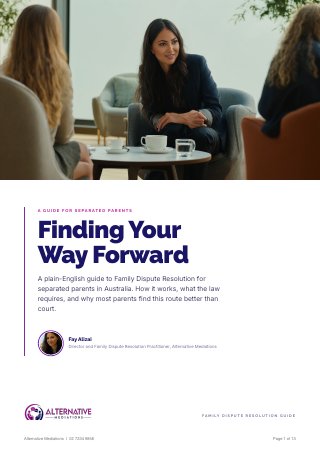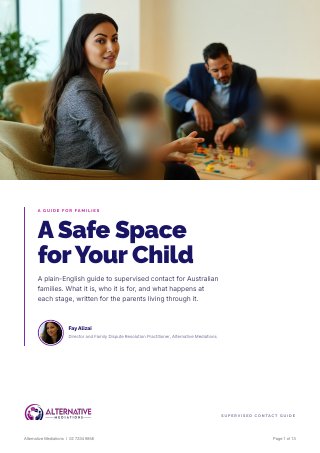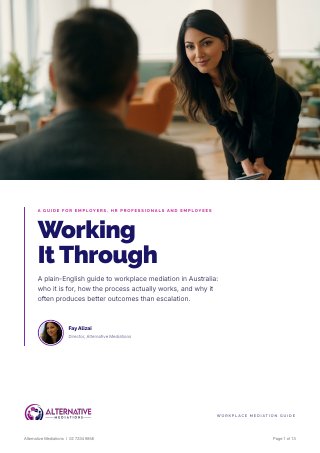

Mediation is typically faster and considerably cheaper than court, and gives both people a say in the outcome rather than leaving it to a judge.
Listen to this article
Mediation is generally faster and considerably cheaper than court, and it gives both people a direct say in the outcome instead of leaving the decision to a judge. That difference in cost and control is why mediation has become the first step for most disputes before anyone considers litigation.
Pricing varies by provider and by the complexity of the matter, so treat any figure as general market context rather than a quote. Based on fee information published by established Australian mediation providers, private family mediation is commonly reported in the range of roughly 2,500 to 7,500 dollars per party for a complete process, covering intake, sessions and a written agreement. Contested litigation for a comparable family matter is commonly reported reaching tens of thousands of dollars once solicitor fees, any barrister involvement and court time are added together, and that figure climbs further the longer a case runs.
Workplace and commercial disputes follow a similar pattern. Mediator time is typically billed by the hour or the day, while a contested Fair Work claim or a commercial dispute that ends up in litigation carries legal fees on both sides, plus the time cost of key people being pulled away from the business.
Mediation compresses a dispute into a small number of structured sessions, while litigation involves drafting, filing, waiting for court dates, and often multiple rounds of correspondence between solicitors before a hearing is even scheduled. That difference in process, not a lower standard of resolution, is where the cost gap comes from.
Court timelines are largely outside your control. Filing a matter puts you into a queue set by the court's own caseload, and in busy jurisdictions that queue can run to many months before a first hearing, let alone a final judgment. A mediation process, by contrast, can usually begin within days of an enquiry and often concludes within a matter of weeks, because the only people whose availability matters are the parties, their mediator, and whoever else needs to be in the room.
Wondering whether mediation could help your situation?
This does not mean every mediation is quick. A dispute with several sessions of substance, several people involved, or a genuinely complicated set of facts will take longer than a simple two-party disagreement. But even a lengthier mediation rarely approaches the timeline of a contested court matter.
This is the part that often matters most, once people understand it. In court, a judge hears both sides and makes a ruling. Neither party gets to shape that ruling directly, and the result is binary: one side's position is generally favoured over the other's, at least on each specific point in dispute.
In mediation, the people involved negotiate their own agreement, with the mediator managing the conversation rather than deciding the content. This tends to produce outcomes that both people can actually live with, because they had a hand in shaping them. It also tends to preserve relationships better, which matters enormously when the people involved will keep dealing with each other afterwards, co-parenting arrangements, ongoing business partnerships, or family members who will be at the same gatherings for years to come.
Mediation is not a substitute for legal advice, and a mediator cannot tell you what your legal rights are or guarantee a particular result. If your matter genuinely needs a court order, for example because the other party will not engage at all, mediation is not going to replace that. What it can do is resolve the parts of a dispute that are genuinely negotiable, often leaving only a narrow, specific issue for a court to decide, if anything at all.
It is also worth being clear that mediation is voluntary. Both people need to be willing to sit down and talk in good faith. Where one party refuses to engage, or where there is a safety concern, mediation may not be appropriate, and a good practice will say so honestly rather than pushing you through a process that will not work.
For most family, workplace and elder-related disputes, mediation is worth trying first, given the real difference in cost, time and the degree of control it gives you over the result. Court remains available for anything that genuinely needs a binding ruling, or for situations where mediation has already been tried and could not resolve the issue. A confidential conversation about your specific situation is usually the fastest way to work out which path makes sense, before any cost is committed either way.
Across the Australian market, private family mediation is commonly reported in the range of roughly 2,500 to 7,500 dollars per party for a full process, based on published fee pages from established providers. Litigation through the courts for a comparable family dispute is commonly reported running into the tens of thousands of dollars once solicitor fees, barrister fees and court time are added up, so the gap in cost is substantial. These are general market figures, not a quote, and your own cost will depend on the complexity of your situation.
In the great majority of cases, yes, because mediation typically resolves in weeks rather than the months or years a contested court matter can take, and legal fees are billed by time. There can be exceptions, for example a very short, simple mediation process compared to an uncontested court filing, so it is worth asking any provider for a general sense of process length before you commit.
A mediation process commonly runs from a few weeks to a few months, depending on how many sessions are needed and how complex the issue is. A contested court matter, by comparison, can take a year or more from filing to judgment, particularly in family and civil courts with heavy caseloads.
In mediation, the two people involved shape and agree to their own outcome, with the mediator helping the conversation along but never deciding for them. In court, a judge or magistrate makes the final decision, and neither party controls what that decision will be.
Yes, mediation does not remove your legal options. If an agreement cannot be reached, or only partly reached, you are free to pursue legal advice or court action on whatever remains unresolved.
Alternative Mediations provides About Mediation mediation across Australia, in person or online. Initial enquiries are confidential and obligation-free.
Book a Confidential ConsultationGet in touch for a confidential conversation. We will explain the process and help you understand whether it is right for your situation.