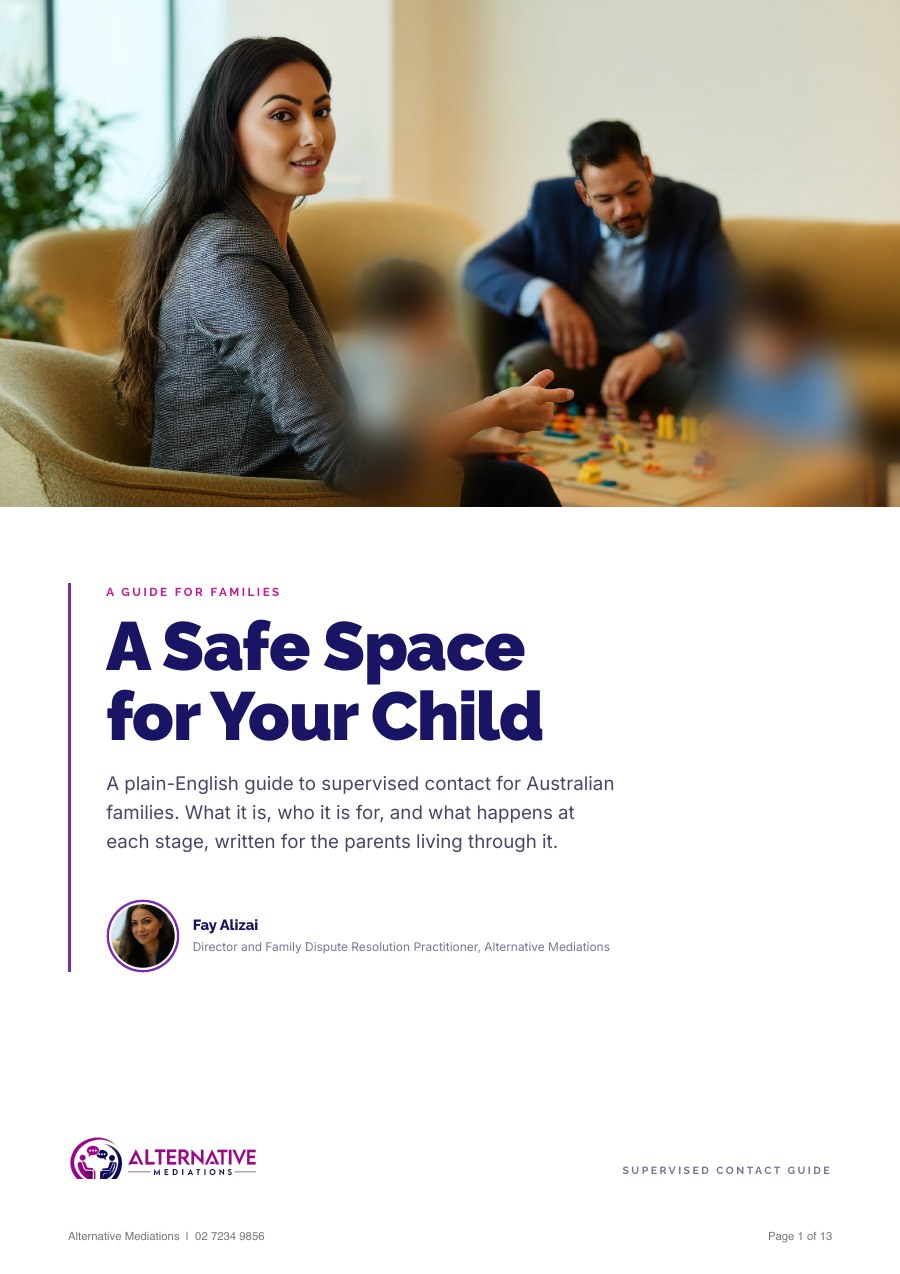
A plain-English guide to supervised contact for Australian families. What it is, who it is for, and what happens at each stage, written for the parents living through it.
Written to be read in one sitting, and to answer the questions people usually save up for the first phone call.
Who this guide is written for, and what it sets out to do.
Court Orders, safety concerns, rebuilding a relationship, and extended family.
Enquiry and assessment, intake, sessions, review and reporting, and what a session looks like.
How confidentiality differs from mediation, Court Orders, and the two questions parents ask most.
Predictability for children, relief for the other parent, and building trust over time.
The nine services across family, workplace and later life.
Deciding between in person and online based on what your child needs.
How to book, and what happens on that first call.
Supervised contact is for families where a child's time with a parent or family member needs the support of a neutral professional, usually because of safety concerns, high conflict, Court Orders or child protection considerations. The guide is for you if any of these sound familiar.
Want the service itself rather than the guide? See our Supervised Contact service.

Fay is a Director of Alternative Mediations and an accredited Family Dispute Resolution Practitioner. She runs sessions in English, Dari, Farsi, Tajiki and Hazaragi, online anywhere in Australia or at the practice's rooms in Canberra. She wrote this guide so that the first phone call feels less daunting.
“Knowing what to expect matters enormously to a child. When contact happens in the same kind of setting each time, with a familiar, steady adult present, and without the pressure of parental conflict in the room, a child is free to simply spend time with their parent.” From A Safe Space for Your Child
Not necessarily. Supervised contact is often required by a Court Order, but families also arrange it by agreement, without any Court involved, where there are safety concerns or where a relationship is being carefully rebuilt after a period apart. If a Court Order does exist, sharing it with us early lets us build the process around it.
Sessions are not confidential in the way mediation is. Records may be kept and shared with relevant parties where agreed at the outset, and also where the law requires disclosure, for example if there is a concern about your child's safety. We explain exactly what that means for your situation before a single session takes place.
Yes. Supervised contact is most often between a child and a parent, but grandparents, siblings and other family members can also be part of an arrangement, depending on what your family needs.
Enter your details and the download opens straight away.
You do not need to read the guide first. Call us for a confidential conversation about your situation, with no pressure and no obligation.